
Myosotis scorpiodes, or forget-me-nots, are a small blue flower that received its name from an old French tale in which a knight throws a bouquet he picked into a lake where his lover had drowned. “Forget me not!” he begs. Though solemn, forget-me-nots are regarded as one of the most precious symbols of steadfast love. Memory and remembrance are powerful feelings that are significant to life, whether in connection, communication, or learning.
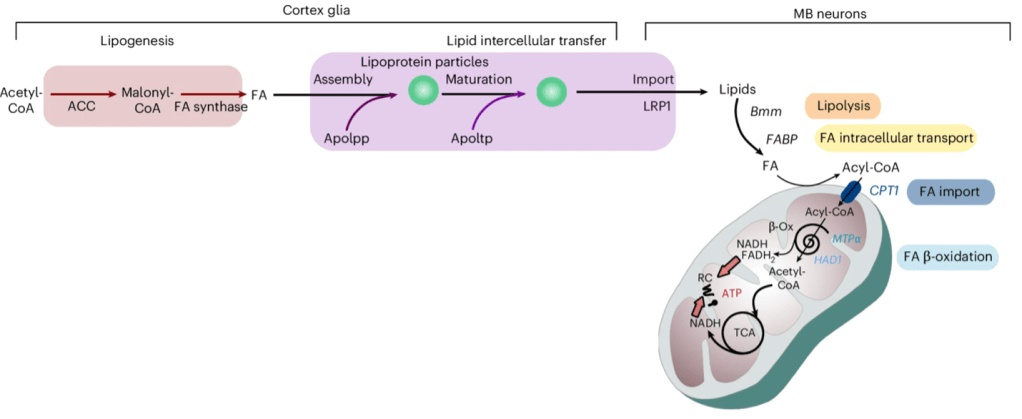
To effectively make memories, scientists have recently discovered that fatty acids are an important fuel source for neurons after bouts of intensive learning [1]. Our body uses the nutrients we consume to make ATP, the main energy currency that fuels our body. The ability to switch between fuel sources such as sugar (glucose) or lipids (fatty acids) is termed “metabolic flexibility.” It has been long thought that the brain primarily consumes glucose for energy, making it somewhat inflexible. Recent work has challenged that notion, highlighting fatty acid consumption, or oxidation (FAO), as an alternative fuel source in the brain [1,2,3]. In this work, Pavlowsky and colleagues use fruit flies to demonstrate the source and mechanism of fatty acid oxidation (FAO) in neurons and its role in memory formation.
NEURONAL FATTY ACID OXIDATION COUPLED TO GLIAL LIPOGENESIS
In this study, flies are tested on their ability to remember the association between a certain odor and an electric shock. Failure to respond to this Pavlovian olfactory conditioning can indicate poor memory formation. By using this testing with functional genomics, scientists can knockout or overexpress certain genes that might contribute to improved or hindered memory scores.
In a series of genetic manipulations, the authors discovered in neuronal cells, fatty acid import into mitochondria and subsequent FAO is necessary for memory formation after intensive massed learning, like crammed learning. This observation is most strange given that neurons tend to avoid FAO due to the generation of toxic peroxide byproducts that they cannot effectively clear. Given their limited need for lipids, neurons also cannot effectively store lipids either. Glial cells, on the other hand, can do so without toxicity, which makes them a prime candidate as the primary lipid source for surrounding cells. When glial cells lose their ability to make lipids (lipogenesis), the flies once again experience a memory defect after intensive learning. The same result occurs when the ability to store and export lipids via lipoproteins is impaired. Surely, the same phenotype in two separate cell types must be connected. Most interesting, knocking down lipoprotein receptors in neurons—eliminating the ability to internalize lipids into neurons—demonstrates the same defects. Collectively, these findings show that glia-derived lipids must be exported, taken up by neurons, and oxidized in neuronal mitochondria to support memory formation after intensive massed learning.
THE MITOCHONDRIA IS THE POWERHOUSE OF THE CELL
Fatty acid oxidation occurs in within the mitochondrion of a cell, so it’s unsurprising to find changed function and shape of this small organelle in adaptive processes like increased specialized fuel consumption. In fact, mitochondria are already known to be remarkably flexible; mitochondria dynamics, which include the fusion and division (termed “fission”), can dictate cell state and health [4].
To support increased FAO demand after the flies’ intense learning, their neurons undergo mitochondria fusion to create elongated versions that increase metabolic activity to generate more energy. Furthermore, elimination of the gene that allows fusion to occur causes a learning defect that prevents memory formation. Collectively, these data highlight the imperative role of fatty acids and mitochondrial fusion in the role of memory formation, especially in crammed learning modes.
Together, these findings reframe memory formation as a metabolically adaptive process, revealing that neurons can flexibly harness glia-derived fatty acids and mitochondrial remodeling to meet the energetic demands of intensive learning. By linking metabolic cooperation between brain cell types to the persistence of memory, this work opens new avenues for understanding how energy balance shapes cognition and how its disruption may contribute to memory disorders.
Written by Caitlyn Dang
Read more about this publication:
Neuronal fatty acid oxidation fuels memory after intensive learning in Drosophila. Pavlowsky et al., Nature Metabolism (2025)
References:
[1] DOI: 10.1038/s42255-025-01416-5
[2] DOI: 10.1038/s42255-025-01321-x
[3] DOI: 10.1038/s42255-025-01389-5
[4] DOI: 10.1038/s41392-023-01547-9


Leave a Reply