

Menopause is a period of immense biological change for women. Once eggs stop being developed and periods end, estrogen, a key sex hormone, is no longer produced at the same levels it once was. This change in ovarian function leaves women living one-third of their lives in an estrogen-deficient state. Without estrogen, major systems fall out of balance. Many women encounter severe hot flashes, causing immense sweating and discomfort, and their bodies may undergo physical changes such as weight gain, hair thinning, or joint aches. However, one major source of distress is declining cognition and mental clarity–otherwise known as brain fog2. For women encountering menopause, brain fog is one of the main debilitating complaints and comes with increased anxiety, difficulty concentrating, and can hinder the ability to think clearly. Treatments for menopause include menopause hormone therapy (MHT), which supplements women with the estrogen their body lacks; however, MHT only focuses on the physical symptoms of menopause rather than the mental.
Estrogens have been shown to be neuroprotective, suggesting hormone therapy could be a promising avenue for treating menopause-associated neurodegeneration. However, no clear therapeutic strategies have been proposed to use estrogen as a neurological treatment. In “Targeting hormone treatment for the brain in menopause” by Noriko Itoh et al., the authors aim to advance the use of estriol, one of the three main types of estrogen, to treat brain fog in menopausal women3.
Estriol is a weaker form of the estrogen hormone and is mainly produced by the placenta during pregnancy. Unlike estradiol, the most common and potent form of estrogen, estriol preferably binds to estrogen receptor beta (ERβ) rather than alpha (ERα). Previous work has shown that the two receptors can play different roles depending on the organ and tissue. Within the brain, ERβ has been shown to be neuroprotective by limiting neuron loss. Further, women who have multiple sclerosis (MS), a chronic nerve disease, often experience symptom relief during the later stages of pregnancy, when estriol is highest. Since estriol may be neuroprotective, Itoh et al. tested whether the estriol treatment that helps women with MS could also help during menopause.
The authors conducted a trial in which menopausal women (~53.5 years old) were treated with an estriol-containing drug known as Pearlpak. Participants were then tested with the Voskuhl Menopause Brain Fog Assessment before and after 12 months of treatment. This assessment evaluates general brain fog, concentration, short-term and verbal memory, processing speed, and problem-solving abilities. After one year on Pearlpak, participants improved in all cognitive domains evaluated in the assessment, and these results were not confounded by factors such as age. This trial shows immense potential for estriol to assist in treating brain fog in menopausal patients.
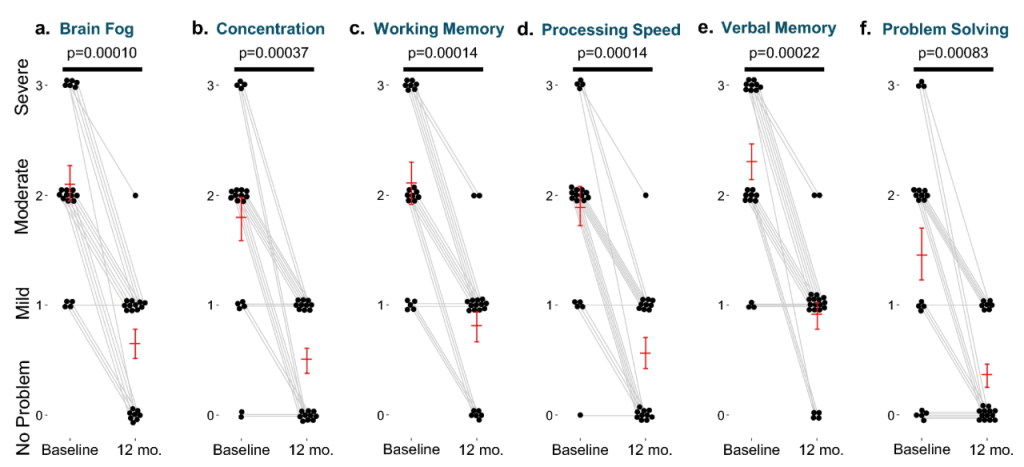
Figure 1. Measurements of cognitive domains (brain fog, concentration, working memory, processing speed, verbal memory, and problem solving) rated as: no problem, mild, moderate, and severe in menopausal women before and after 12 months of estriol (Pearlpak) treatment.
Following the human trial, the authors looked at specific changes that menopause and estriol treatment can have on the brain using a menopausal mouse model. The mice had their ovaries removed to mimic the estrogen deficiency that occurs during menopause and were aged 12-14 months old, which recapitulates the average menopausal age. The mice were then either given a vehicle treatment, expected to have no effect, or estriol at a similar dose given during MS preclinical trials. Without estriol treatment, there was severe synaptic loss, which are the connections between neurons that allow them to send signals. This was driven by glial cell activation, a special cell type that can eliminate synaptic connections, associated with a decrease in cognition. However, when treated with estriol, this negative effect was rescued to normal levels.
Previous work has shown that during menopause, expression of the gene enolase 1 (ENO1) increases in the brain. ENO1 is an enzyme involved in cellular energy metabolism, and high levels of ENO1 can contribute to neurodegeneration. Commonly seen in diseases such as Alzheimer’s, the brain attempts to compensate for a lack of energy by increasing ENO1; however, stress causes damage to the enzyme, making it nonfunctional, which then reduces energy further and can accelerate neuronal death4. Through their menopausal mouse model, the authors confirmed that ENO1 levels were increased in the brain. Further, they selectively depleted ERβ in non-estrogen-deficient mice and again saw increased ENO1 levels. Through supplementation of either ERβ or estriol, they found ENO1 levels were normalized to wild-type levels. These experiments suggest that ERβ and estriol are both protective in the brain.
Together, Itoh and colleagues demonstrate the potential of estriol treatment for cognitive performance and brain fog in menopausal women, while also elucidating a potential mechanism of action of estriol on the brain. This work further highlights the importance of balancing the estrogen types used for treatment during MHT depending on specific symptoms ranging from physical to mental health. With estriol supplementation in MHT, menopausal women may finally reclaim that one-third of their life back with a brain cleared of fog.
Written by Michelle Seeler
References:
[1] Barr, L. (2026, January 30). Brain fog in diabetes: Can diabetes give you brain fog? SensIQ. SensIQ article (Image)
[2] Haupt, A. (2025, November 14). How to deal with brain fog during menopause. TIME. TIME article
[3] Itoh, N., Itoh, Y., Patil, R. et al. Targeting hormone treatment for the brain in menopause. Sci Rep 16, 25901 (2026). https://doi.org/10.1038/s41598-026-65603-4
[4] Liu F, Li H, Hong X, Liu Y and Yu Z (2024) Research progress of neuron-specific enolase in cognitive disorder: a mini review. Front. Hum. Neurosci. 18:1392519. doi: 10.3389/fnhum.2024.1392519


Leave a comment